



On June 4, Bonree successfully hosted its seminar “Breaking Through the Black Box: AI Model Evaluation, Cost Truth, and Observability Practices.”
Based on the “May 2026 China Mainstream LLM API Performance and Comprehensive Evaluation Report,” the study analysed more than 1,900 real-world cross-city public network tests, challenging laboratory benchmark assumptions and revealing real-world performance limitations, scenario-based divergence, and hidden cost gaps across leading LLMs.
Combined with the AI observability capabilities of Bonree ONE 4.0, the seminar delivered a complete end-to-end framework covering model selection, cost optimisation, and AI application observability, helping enterprises address key challenges such as model selection uncertainty, cost opacity, and operational complexity.
Below is the edited Q&A transcript from the seminar.
1. Why We Built the Benchmark: Filling Industry Gaps and Ending AI Information Black Holes
Q1: What was the motivation behind the report?
As AI large models move from labs into production environments, we identified a clear information vacuum. Decision-makers often rely on vendor marketing materials and fragmented reviews, with no objective, measurable production-grade data.
This situation mirrors traditional IT monitoring before observability existed, where diagnosis was based largely on feel.
Key pain points include:
First, high cost of wrong model selection, where switching base models in production is extremely expensive.
Second, lack of service transparency, where real-world SLA performance often diverges significantly from vendor claims.
Third, underestimated cost risks, where token consumption differences become invisible at small scale but explode under production workloads.
This report extends Bonree’s core philosophy of making systems observable to the LLM infrastructure layer.
Q2: How were subjective user experiences converted into measurable metrics?
We decomposed user experience into three measurable dimensions.
Performance metrics include time-to-first-token, total response time, and token generation speed measured at millisecond level.
Quality metrics are based on AI evaluation across correctness, logical consistency, code executability, and task completion, converted into a 0–100 scoring system.
Stability metrics are derived from continuous sampling across multiple cities and time periods, with more than 1,900 calls collected to reflect real production variability.
This methodology is based on APM principles and extends them into LLM evaluation scenarios.
Q3: What is fundamentally different between this benchmark and academic benchmarks?
Academic benchmarks evaluate models under ideal conditions and focus on capability ceilings.
Enterprise evaluation focuses on stable performance under real production conditions.
The key differences include real network environments across multiple cities, production-relevant task scenarios, and long-term sampling rather than single-point testing.
This allows us to observe stability degradation that does not appear in laboratory settings.
2. Methodology: Turning Subjective Experience into Objective Standards
Q4: Why were the four scenarios chosen?
We selected code generation, mathematical reasoning, task planning, and hallucination control.
These represent the most critical enterprise AI application scenarios.
Code generation supports engineering productivity. Mathematical reasoning supports financial and analytical workloads. Task planning is central to AI agents. Hallucination control determines trustworthiness.
Other dimensions such as multimodal and tool calling were not included due to lower enterprise adoption maturity at this stage.
Q5: Any surprising findings?
We observed strong scenario duality across models.
Kimi K2.6 Thinking achieved high performance in hallucination control but showed only 50 percent usability in code generation due to timeout issues under heavy computation.
We also observed nearly two times difference in token consumption between the most efficient and most expensive models, which becomes significant at scale.
Q6: How do you ensure fairness in AI-based evaluation?
We use a multi-layer validation approach.
This includes structured scoring rubrics, ground truth verification where available, repeated evaluation consistency checks, and human review for high variance cases.
We also explicitly document limitations, particularly for creative tasks, to maintain transparency.
3. Insights from Model Evaluation: No Universal Winner, Only Scenario Optimisation
Q7: Should enterprises prioritise overall best or scenario best models?
It depends on architecture strategy.
Single-model systems prioritise balanced performance across scenarios.
Multi-model agent systems optimise per scenario selection.
From an observability perspective, unified monitoring across models is essential for managing this complexity.
Q8: Why do models perform differently across scenarios?
This is due to differences in reasoning architecture and infrastructure constraints.
Deep reasoning models perform well in hallucination control but may face latency and timeout issues in high-load tasks such as code generation.
This highlights the importance of continuous monitoring in production rather than one-time evaluation.
Q9: What is the cost impact of token consumption differences?
Based on test results, DeepSeek-v4-pro consumes about 2,680 tokens per task while Qwen3.6-plus consumes about 4,930 tokens per task.
For an enterprise with 10,000 API calls per day, this results in significant annual cost differences that can scale from tens of thousands to millions depending on pricing structure.
Cost optimisation therefore requires continuous observability rather than static model selection.
4. Bonree ONE 4.0: Closing the Loop Between Evaluation and Operations
Q10: Relationship between the report and Bonree ONE 4.0?
The report supports model selection while Bonree ONE supports ongoing operational governance.
The report is a static snapshot, while AI systems are continuously evolving.
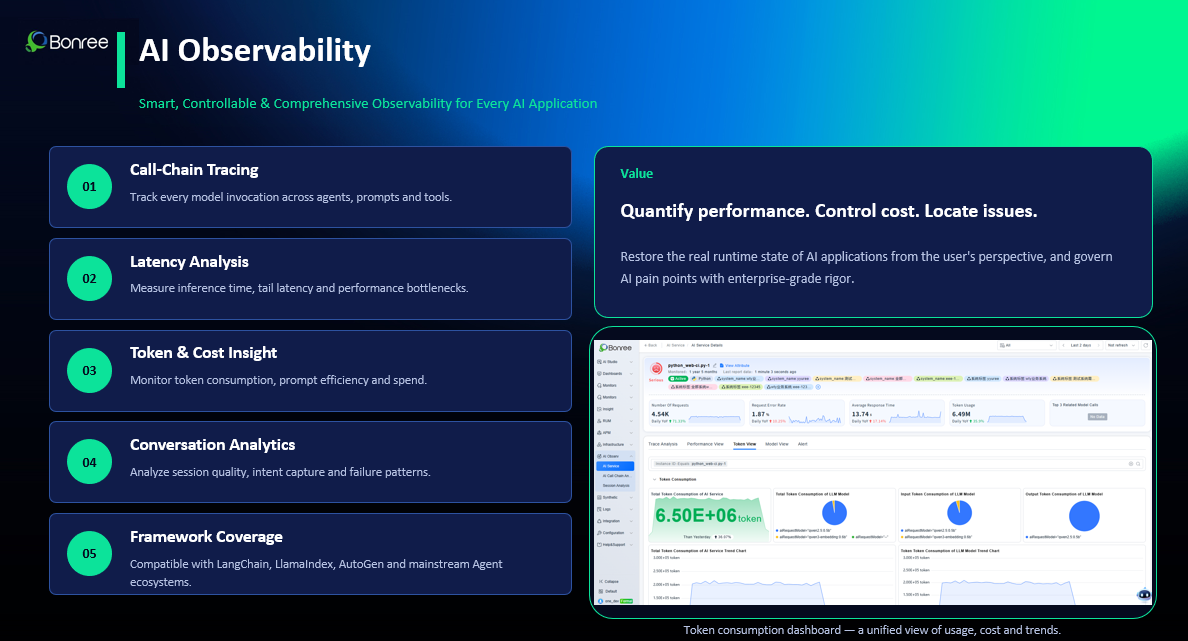
Bonree ONE monitors latency, cost, availability, and output quality in real time, creating a closed loop from selection to validation to optimisation.
Q11: What is the biggest barrier to adopting AI observability?
The main barrier is not technical complexity but prioritisation.
Many teams focus on rapid AI deployment, while observability is seen as secondary.
Integration concerns with existing monitoring systems and data security concerns are also common.
Bonree ONE addresses these through unified observability and private deployment options.
Q12: How is AI observability different from traditional IT monitoring?
Traditional monitoring focuses on binary system states such as up or down.
AI systems introduce new failure types, including quality degradation without service failure, cost explosion from inefficient token usage, and multi-step chain failure propagation.
These cannot be detected using traditional APM tools.
5. Future Outlook: Industry Trends and Key Risks
Q13: Will models converge into a universal model?
In the short term, model differentiation will continue due to architectural trade-offs.
In the long term, convergence is more likely to occur at the routing layer, where systems dynamically select the most suitable model for each task.
Q14: How will the benchmarking project evolve?
The goal is to build a continuously operating evaluation system with higher frequency updates, expanded dimensions, open ecosystem collaboration, and integration into live observability platforms.
Q15: What is the biggest enterprise AI risk in the next 1 to 2 years?
The biggest risk is lack of visibility.
This includes AI cost blind spots, quality drift caused by silent model updates, and compliance risks in multi-model environments.
These directly map to cost visibility, quality visibility, and traceability in AI observability systems.