




Bonree ONE·Sage AI is the AI Agent operations workspace of Bonree ONE, Bonree’s AI-driven observability platform. It lets operations teams build, publish and run AI agents for inspection, diagnosis and Q&A, and it turns the know-how of senior engineers into capabilities that are configurable, reusable and schedulable across the whole team.
This article follows one concrete scenario: building a database inspection agent and using it to analyze a live environment. Along the way it shows how the workspace is structured, how an agent differs from a chatbot, and what changes when operational experience becomes a managed asset instead of something that lives in a few people’s heads.
The real bottleneck is experience, not tooling
Most enterprises do not suffer from a shortage of monitoring tools. They suffer from experience that cannot be reused. A senior engineer’s instinct for what to inspect, how to read a fault and how to analyze a slow SQL statement is hard to pass on. Each team evolves its own inspection routine, its own thresholds and its own report format.
Three structural problems follow. The same inspection task produces results of very uneven quality depending on who runs it. Years of accumulated judgment leave the company when a senior DBA does. And because incidents often strike outside working hours, the window for a human response is narrow. Without a purpose-built way to package expertise, these gaps widen as the environment grows.
A four-layer model for building and running agents
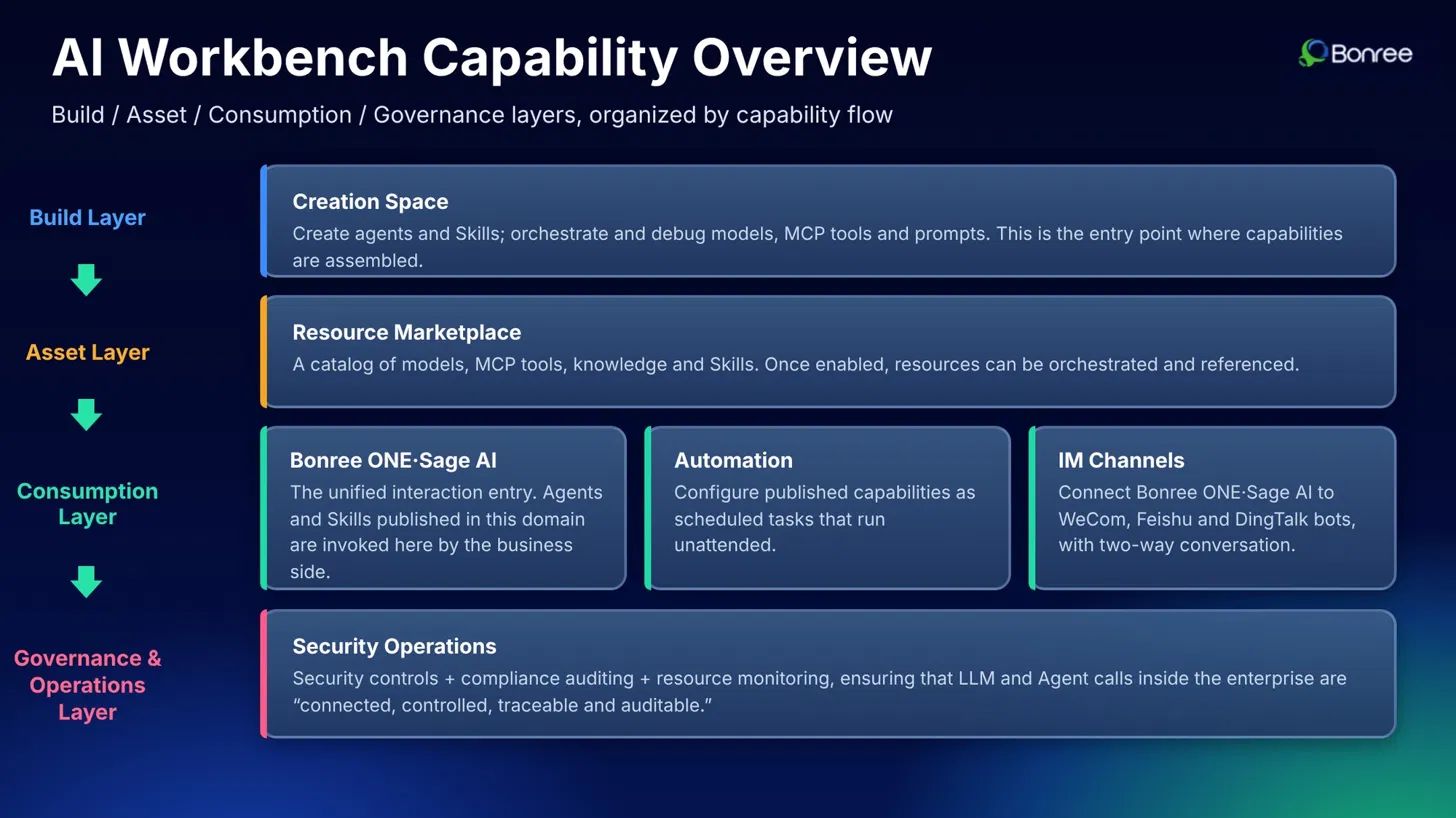
Bonree ONE·Sage AI organizes agent work into four layers, each matched to a different stage of producing and consuming a capability.
The build layer is the creation space for developers. This is where agents and Skills are created, and where models, MCP tools and prompts are orchestrated and debugged. Once a resource is ready, it moves to the asset layer, a catalog of MCP servers, knowledge, Skills and agents. Publishing to this catalog is what makes a resource discoverable and reusable by other roles.
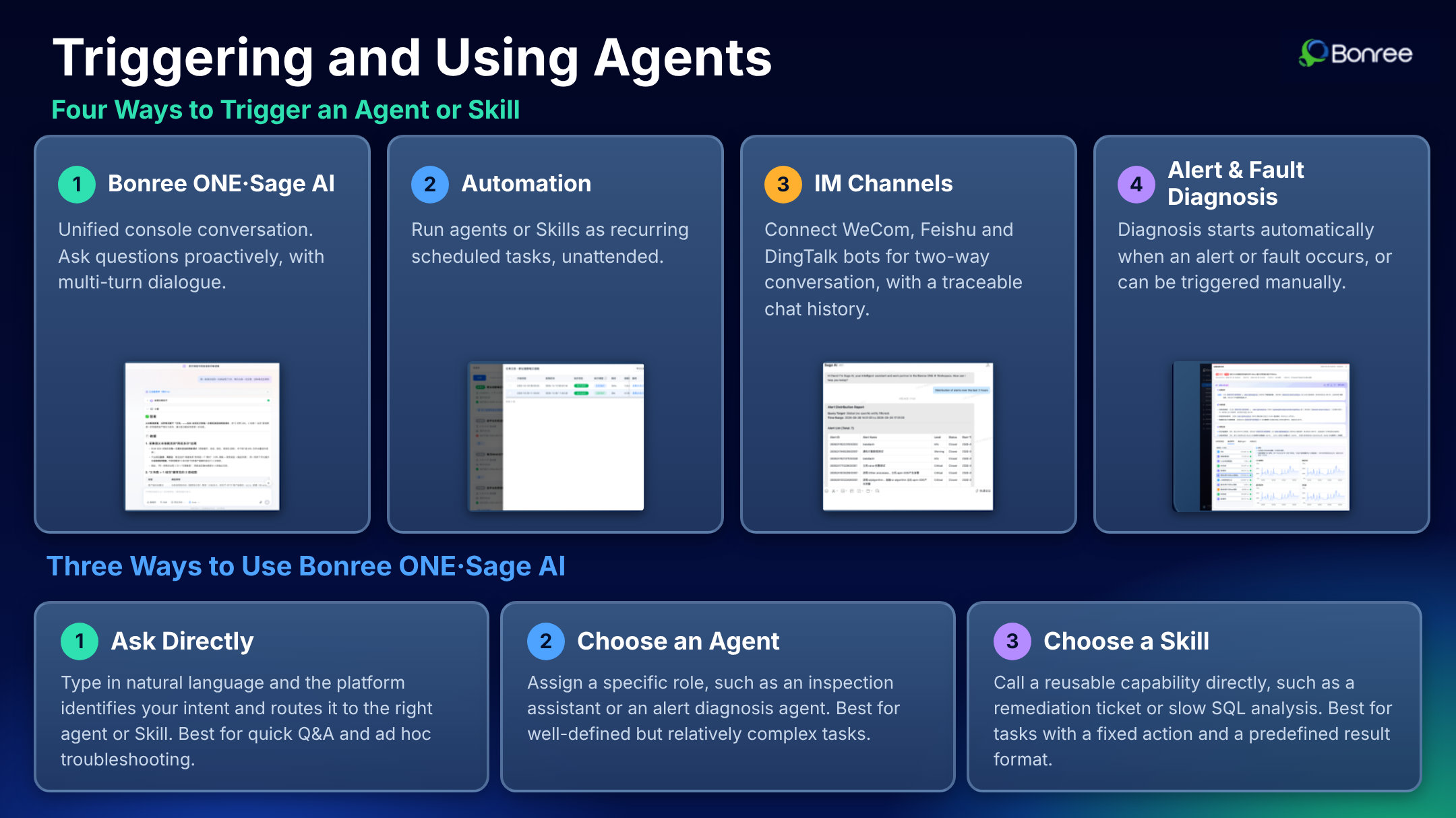
The consumption layer is where published agents meet the business. Teams can reach them through the Bonree ONE·Sage AI interface itself, through scheduled automation, through IM bots on WeCom, Feishu and DingTalk, or directly from the alert list as a diagnosis entry point. Underneath all three sits the governance layer, which handles security controls, compliance auditing and resource monitoring, so that every LLM and agent call inside the enterprise is connected, controlled, traceable and auditable.
The result is a clean division of labor. Developers incubate capabilities in the creation space, operators pick up finished agents from the catalog, and managers rely on governance for security and compliance, all within one consumption system.
Orchestration, not just conversation
What separates an operations agent from a chatbot is what happens beyond the dialogue: resources are orchestrated and capabilities are packaged. Each resource has a defined job. The model reasons and plans, but does not fetch data itself. MCP retrieves data on demand. Knowledge supplies the criteria for judging what is normal and what is not. Skills are self-contained execution units that complete a task. Prompts fix the order of steps and the conditions that trigger them, and automation handles scheduling. Keeping these responsibilities separate gives every resource a clear contract with the others.
The relationship between an agent and its Skills is easiest to picture as a restaurant. The agent is the manager: it plans, decides whether the next move is to pull data, consult knowledge or call a Skill, and then takes the result back to continue deciding. A Skill is the standard recipe for one dish. It is prepared only when ordered, follows the recipe, and returns the finished plate.
Bonree ONE·Sage AI supports two kinds of agents. Workflow agents move through predefined nodes, which suits processes with stable paths, clear steps and a need for tight control. Autonomous agents let the model plan the path and dispatch resources, which suits complex scenarios where the route is not known in advance. Between them they cover the two typical shapes of enterprise work, and both are invoked the same way through Bonree ONE·Sage AI.
Case in practice: a database inspection expert
The demonstration scenario was a “database call inspection expert”. Its workflow has five stages: confirm the target and time range, take stock of the available data, run five checks in turn, rank findings by impact, and produce an inspection report. Every check has a defined method and reference thresholds.
Building it in the creation space followed four phases: get the resources ready, orchestrate the capabilities, publish and list the agent in the catalog, and call it online. Once published, the task itself was a single sentence: inspect database calls from the past hour and analyze any anomalies and their causes.
From there the agent worked through its workflow on its own. In about four minutes it covered 14 database targets with call traffic and located two key risks.
The first was critical. A DB2 database showed a reproducible data-truncation error, with an interface-level error rate of 38.09% across 211 occurrences, concentrated on specific interfaces. The agent hypothesized that the application was writing values longer than the column definition, or that a recent data-model change had not been matched on the application side. It proposed actions for both sides: on the calling side, identify the triggering interface and SQL template and check the length of incoming parameters; on the database side, confirm whether the target table’s column definitions changed recently.
The second was a warning. An ODS database showed clustered slow queries, with a single SQL statement averaging 1,582 ms and peaking at 8,815.82 ms. The agent pointed to missing indexes, stale statistics or resource contention as likely causes, and again split its recommendations between the two sides: analyze the query pattern of the slow SQL template on the calling side, and check index usage, statistics freshness and lock waits on the database side.
What makes the report trustworthy is how it handles certainty. It labels each diagnosis as either a confirmed conclusion or a leaning judgment. The truncation error was confirmed, with an error stack behind it. The internal cause of the slow SQL was marked as a leaning judgment that needs verification on the database side. Every finding separates established facts from inference, and names the next step that can be taken from each side. The report closes with data gaps and risk notes, stating plainly that its conclusions rest on call-side data only.
Work that would typically take a senior DBA several hours, including cross-checking, locating problems and writing the report, came back as a structured, standardized and traceable analysis. It included severity classification, symptoms, scope of impact, supporting evidence, probable causes and remediation steps.
From personal experience to organizational capability
The value of Bonree ONE·Sage AI is not an extra chat window. It changes how operational capability is produced. Capability used to be attached to individual people; now it can be broken down, configured, published and invoked. That shift plays out in three steps.
First, experience stays when people move on. An engineer’s inspection logic, judgment criteria and output standards are captured in prompts, knowledge documents and Skills, so they no longer disappear with staff turnover. For the first time, a team’s accumulated know-how has a home that does not depend on any one person.
Second, one-off analysis becomes reusable capability. Once built, an inspection agent can be called again and again by the team and reused in other scenarios, without starting over each time. Producing capability stops being a craft and starts to look like a standardized pipeline, with a much lower marginal cost.
Third, response moves from reactive to proactive. Agents can be triggered on demand or scheduled, and they are available around the clock. When something breaks, the diagnosis entry point is already there; during routine inspection, coverage is no longer capped by headcount. People keep the decisions and the final safety net, and agents take the repetitive work.
All of this points to one outcome. The ceiling of an operations team is no longer set by how many people it has, but by the configurable, reusable and schedulable agent assets it has built. With Bonree ONE·Sage AI, every enterprise can build up its own team of operations experts.
FAQ
What is Bonree ONE·Sage AI?
Bonree ONE·Sage AI is the AI Agent operations workspace of Bonree ONE. It lets teams build, publish and run AI agents for inspection, diagnosis and Q&A, using models, MCP, knowledge, Skills and prompts.
How is an AI operations agent different from a chatbot?
A chatbot answers questions. An operations agent orchestrates resources: the model plans, MCP retrieves data, knowledge sets the criteria, Skills execute tasks and automation schedules them. The agent decides which of these to use at each step.
What kinds of agents does Bonree ONE·Sage AI support?
Workflow agents, which follow predefined nodes and suit stable, tightly controlled processes, and autonomous agents, where the model plans the path and dispatches resources for scenarios that are not fixed.
How can teams use a published agent?
Through the Bonree ONE·Sage AI interface, scheduled automation, IM bots on WeCom, Feishu and DingTalk, or directly from the alert list as a diagnosis entry point.
How does Bonree ONE·Sage AI keep agent calls under control?
Its governance layer covers security controls, compliance auditing and resource monitoring, so that LLM and agent calls in the enterprise are connected, controlled, traceable and auditable.
About Bonree
Bonree (Bonree Data Technology Co., Ltd.) develops Bonree ONE, an AI-driven observability platform designed to help enterprises monitor, analyze and optimize complex digital environments. With Bonree ONE·Sage AI, organizations can extend observability into AI Agent operations, enabling intelligent diagnosis, analysis and customized operational workflows.