



On July 9, Bonree Data officially launched Sage AI, the intelligent agent platform built into Bonree ONE. This article breaks down Sage AI across three dimensions — product capabilities, the technology stack behind it, and real-world deployment — to show how it's putting AI agents at the center of a new operating model for IT operations.
1. Beyond Manual Firefighting: A New Model for Human-AI Collaboration in Ops
Traditional IT operations has long been held back by reactive alerting, siloed data, and troubleshooting that depends heavily on individual experience — a combination that drags down efficiency and slows response times. Sage AI is designed to break that cycle.
Sage AI serves as the AI capability hub of the Bonree ONE platform, bringing models, tools, skills, and knowledge bases under unified management and supporting agents across their full lifecycle — from initial build to ongoing operation — so they can adapt to virtually any digital operations scenario.
A ready-to-use agent lineup. Sage AI ships with a set of pre-built agents covering core scenarios such as fault diagnosis, database analysis, system inspection, capacity assessment, and change management, with more being added over time. Each agent can independently sense, analyze, decide, and deliver results, and together they form a complete closed loop — from parsing full-stack observability data and pinpointing business risk, to intelligently identifying root causes and automatically producing remediation plans. In effect, they give an organization an expert team that's online 24/7, covers every scenario, and responds with zero delay.
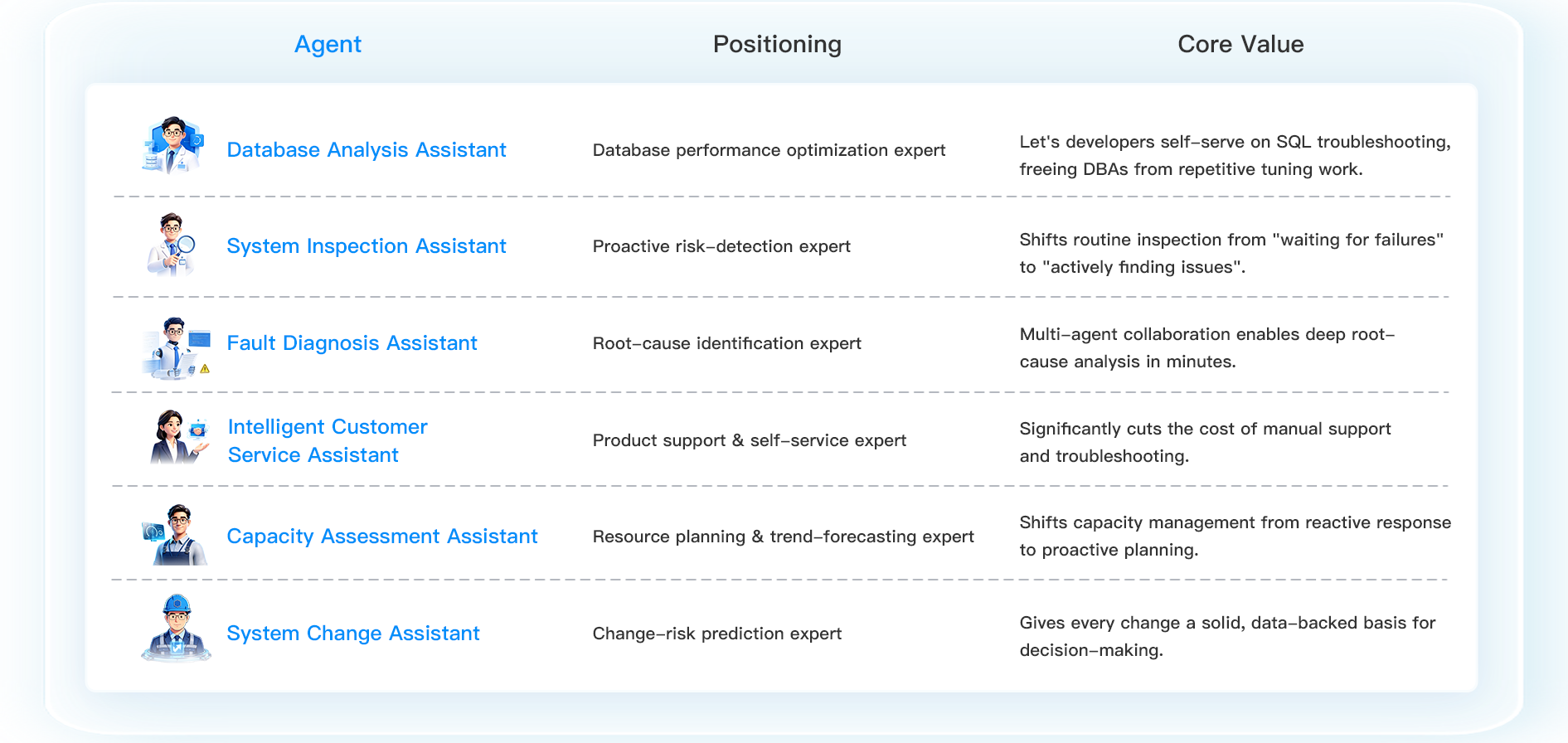
Built to flex: ready-made agents and custom orchestration, side by side. Beyond its out-of-the-box agents, Sage AI lets teams build agents tailored to their own workflows, using two orchestration modes: workflow and autonomous reasoning. Workflow mode suits well-defined, standardized tasks — routine inspections, change approvals — where consistency and compliance matter most. Autonomous reasoning is built for complex incidents where the cause isn't yet known and the agent needs to reason through multiple steps dynamically, playing to AI's strengths in open-ended problem solving. The two modes can be combined — routine work runs on workflows, while unexpected issues get handed to autonomous reasoning — so operations stay both stable and responsive.
2. Under the Hood: A Layered Architecture for Governable AI Agents
Sage AI's capabilities rest on a solid technical foundation — and getting agents to work safely and reliably in production requires more than raw capability; it takes a closed loop of manageability, governance, and operability. To that end, the Sage AI platform is built as a layered architecture, bottom-up, from data ingestion all the way to end-user applications, forming an integrated capability stack for AI-driven operations.
Data source layer — the foundation for everything an agent senses and does. Beyond standard observability signals (logs, metrics, traces, alerts, events), the platform can also ingest an organization's existing ops assets — CMDB records, emergency response playbooks, ITSM tickets, as well as file-level assets like scripts, environment variables, and credentials. For sensitive, high-compliance data, the platform enforces strict permission isolation and access controls, so data governance is secure by design rather than just centrally stored.
Data model layer — a unified model that normalizes every type of observability signal into a single, integrated schema. Bonree pioneered this full-domain data model in the industry, and continued refinement has made it capable of supporting complex cross-signal correlation analysis, providing a consistent, stable data foundation for every application layer built on top.
Agent runtime environment — built on top of that standardized data model, secured through two core mechanisms: sandboxing and orchestration governance, which together give agents a dependable operating framework.
The security sandbox covers file-system isolation, resource isolation, network isolation, execution-permission controls, and multi-tenant isolation, ensuring safe boundaries when multiple agents run concurrently. It's backed by governance capabilities including human-in-the-loop approval, permission-declaration checks, behavioral boundary checks, malicious-instruction interception, and compliance audit logging — together forming a comprehensive line of defense.
Orchestration governance manages agents across their full lifecycle along four dimensions: reliability (fallback strategies, error retries, and circuit breakers), validity (schema validation and compliance checks to ensure execution quality), agility (efficient task decomposition and scheduling via primary-agent routing and multi-agent collaboration), and coherence (long- and short-term memory management with decay-based updates, so agents keep adapting to user habits, reducing manual intervention and improving the overall experience).
Application layer spans the full operations lifecycle — development and testing, release management, routine inspection and maintenance, incident recovery, disaster-recovery drills, and governance. Interaction is flexible, supporting web console access, natural-language conversation, alert-triggered execution, and scheduled tasks.
Rich observability data and ops-asset ingestion give agents what they need to perceive their environment; the structured, full-domain data model gives them a solid analytical foundation; the security sandbox and orchestration governance keep execution trustworthy and reliable; and the application layer is where the operational value actually gets delivered. Together, these four layers — building on one another from the ground up — form the technical foundation of Sage AI, enabling agents to independently carry out the entire ops lifecycle: sensing, analysis, response, and retrospective review.
3. From Zero to One: How Bonree's Own Ops Team Put Autonomous Agent Orchestration to Work
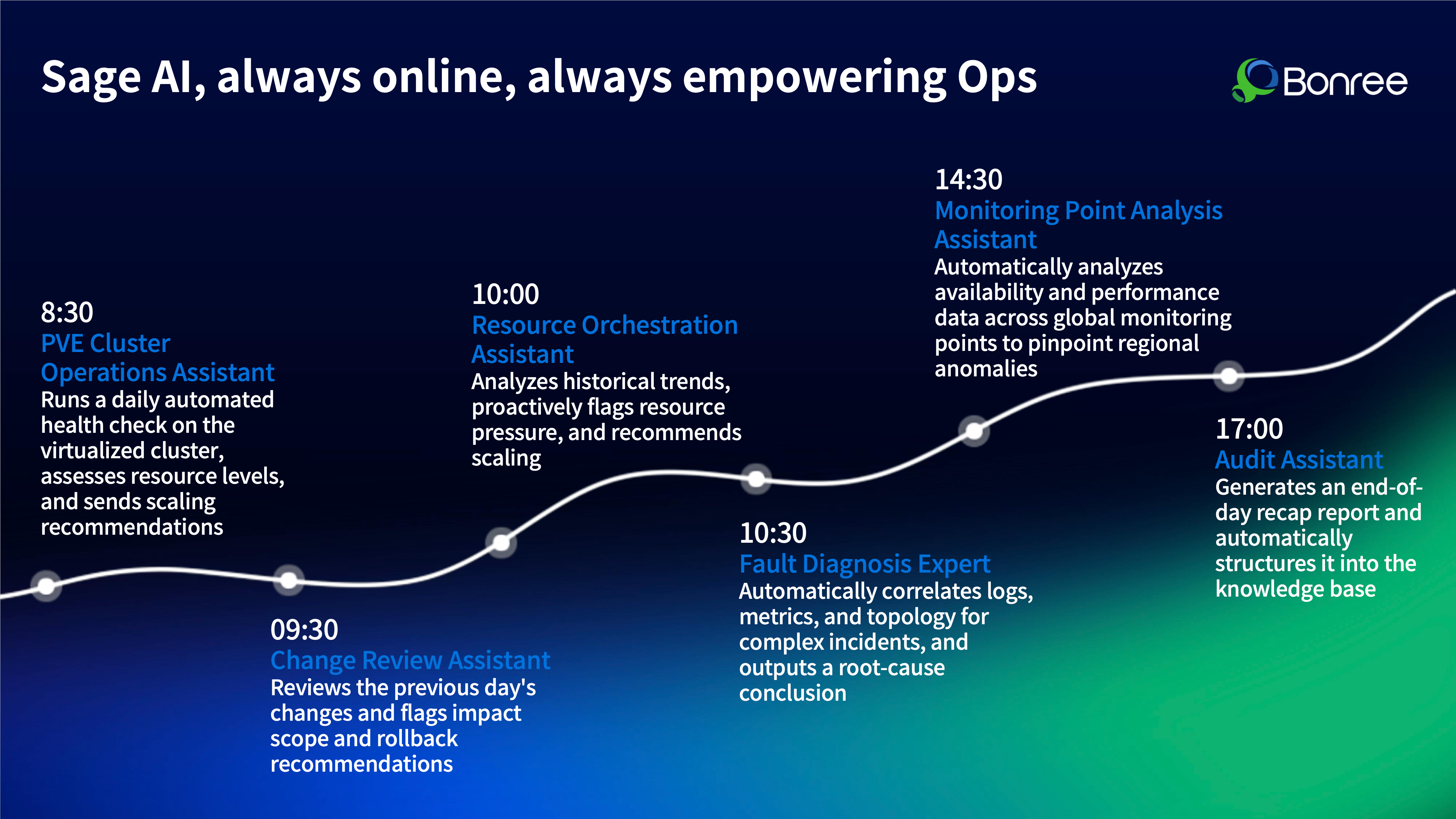
Using Sage AI's flexible orchestration capabilities, an ops team can take an agent all the way from requirements analysis, skill design, and MCP integration, through knowledge injection and testing, to staged rollout — with every step following established ops best practices, so the resulting agent is ready for real production use. Building on this standardized process, Bonree's own operations team — drawing on day-to-day pain points and real business scenarios — has already rolled out agents across six core areas: fault troubleshooting, resource management, change control, cluster operations, monitoring analysis, and compliance auditing. These agents now handle repetitive manual work directly, pushing the team's operations toward greater standardization and automation.
Fault Diagnosis Agent
Built on a hybrid of workflow and autonomous-reasoning orchestration, this agent pulls together Prometheus metrics, Elasticsearch logs, and CMDB topology data, cross-referencing a historical incident knowledge base for deeper analysis. When an incident occurs, it follows the same investigative path a senior engineer would, independently working out the root cause and generating a diagnostic report. Where manual troubleshooting typically takes 40+ minutes, the Fault Diagnosis Agent can complete a diagnosis in a matter of minutes — a major gain in incident response speed.
Resource Orchestration Agent
Packages the standard workflow for requesting, allocating, and configuring resources into a single agent. Developers can describe what they need in plain language — for example, "I need a 3-node Redis cluster" — and the agent handles resource assessment, plan generation, and configuration deployment automatically.
Change Review Agent
Triggers automatically ahead of every system change, querying the CMDB for upstream and downstream dependencies and comparing configuration differences before and after the change (container images, Helm charts, service discovery configs, and more). It cross-references a historical change-incident database to assess risk level, then outputs an impact report and rollback recommendations to support sound decision-making.
PVE Cluster Operations Agent
For PVE and OpenStack virtualized environments, this agent runs daily automated inspections — combining skills like cluster health checks, VM migration assessment, and storage capacity alerts with scheduled tasks — replacing repetitive manual checks. It also evaluates resource-pool utilization, flags scaling needs, and recommends hardware purchases, giving the team a head start on capacity planning.
Monitoring Point Analysis Agent
Bonree operates a large, globally distributed network of monitoring points that needs constant adjustment based on business demand. This agent automatically analyzes availability and performance data across the entire global network, identifies anomalous nodes, pinpoints regional issues, and generates multi-dimensional service-quality reports — turning a sprawling global dataset into a clear, at-a-glance picture and cutting down manual analysis work significantly.
Audit Agent
Connects to operational logs and change records to automatically generate compliance audit reports on a regular basis, flagging unusual activity — shifting security auditing from after-the-fact review to continuous monitoring. For heavy audit workloads, it can log directly into target systems and network switches, automatically collecting compliance data and producing standardized reports, helping teams get through audits efficiently and with confidence.
Giving Every Enterprise Its Own Expert Ops Team
Sage AI is both a ready-to-use expert team — spanning database analysis, system inspection, fault diagnosis, capacity assessment, and change evaluation across every ops scenario — and an open, powerful agent orchestration platform, where models, tools, skills, and knowledge bases can be freely combined, workflow and autonomous-reasoning modes chosen as needed, and automated tasks scheduled on demand.
From out-of-the-box agents to autonomous orchestration, from raw technical capability to a full governance loop — Sage AI lets every enterprise build its own team of AI ops agents, embedding expert-level intelligent operations directly into everyday workflows and turning it into resilience that's measurable and felt across the business.