



SQL problems rarely announce themselves as simply "running slow." Sometimes it's a hidden slow query buried inside an API timeout; sometimes it's a statement that fails outright because of a syntax error; sometimes it's an execution plan nobody can quite make sense of. In a traditional ops model, every one of these cases runs through the same bottleneck: a DBA's personal experience — combing through slow-query logs, checking syntax line by line, reading execution plans. That kind of work has a high expertise bar, doesn't scale, and resists being turned into a standard process. When a developer runs into a SQL-related issue but has no way to investigate it independently, the problem often just sits there — until it grows large enough to become an incident.
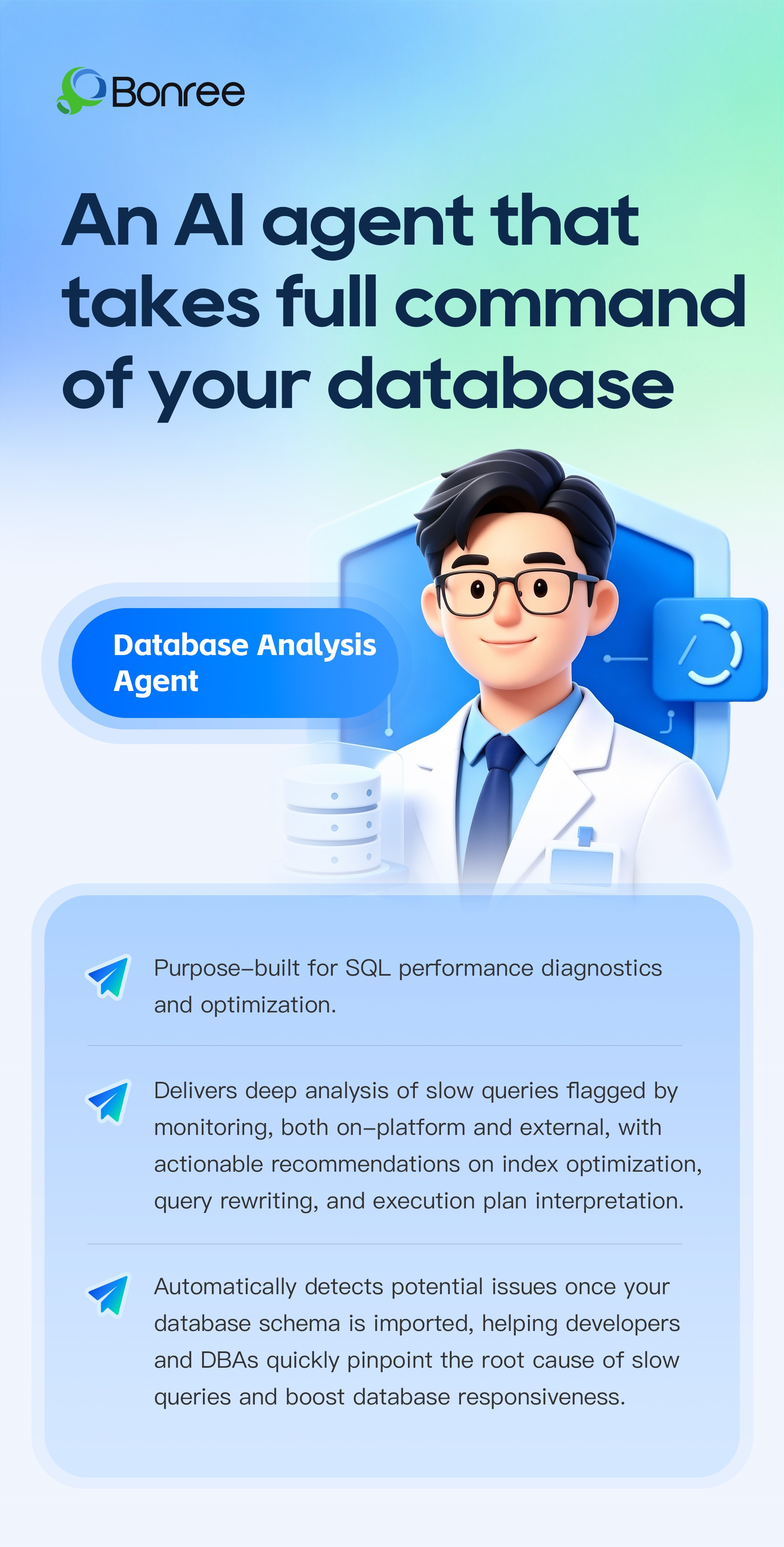
The Database Analysis Agent on the Bonree ONE · Sage AI agent workbench was built to close exactly that gap: it takes SQL diagnostic capability that used to live only in individual DBAs' heads and turns it into an analysis capability anyone on the team can call on demand — covering both slow-query inspection and SQL-text diagnosis. What follows is a walkthrough of one real task.
Fully autonomous, start to finish: from task interpretation to a finished result
The instruction given to it was simple:
"Analyze the database's activity over the last 24 hours, check whether there are any slow SQL queries, and provide recommendations on index optimization, query rewriting, and execution plan interpretation."
On receiving the instruction, the Database Analysis Agent worked through task decomposition, capability loading, data collection, and conclusion generation on its own. After collecting and verifying slow-SQL monitoring data across the entire database for the past 24 hours, the result came back clean: no slow SQL records were found in that window.
A three-layer chain of judgment
A "nothing found" result is common in SQL troubleshooting, but it's also easy to shortchange. A generic automation script would simply return "no data found" and consider the task complete. For the engineer who asked the question, though, that conclusion carries no actionable information: is the database actually running well, or is there a blind spot in the monitoring setup? "No data" alone can't tell the two apart.
Working from that same result, the Database Analysis Agent applied three progressive layers of judgment:
First, it stated a clear conclusion: database query performance was healthy during this period, with no slow-query thresholds triggered.
Second, it questioned the "zero result" itself rather than taking it at face value — the outcome could mean one of two things: the database genuinely is healthy, or the platform's slow-SQL threshold (such as long_query_time) is set too high, letting real performance issues slip past undetected. These two explanations point to entirely different next steps, and treating them as interchangeable risks steering the engineer's next move in the wrong direction.
Third, for each possibility, it laid out a concrete, actionable path to verify it: which specific setting to check if the concern is threshold configuration; how far back to extend the analysis window if the concern is an earlier, unrecorded issue; and which deeper diagnostic path to take if a specific suspect SQL statement is already in hand.
Beyond the conclusion itself, the Assistant also offered three directions for immediate follow-up: viewing real-time database status and active sessions, checking whether the slow-query threshold is set appropriately, and reviewing the slow-SQL trend over the past week. These weren't offered as a disconnected list of features — each one maps directly back to the judgment chain above, addressing the two open questions ("is the threshold reasonable" and "is the time window wide enough") left on the table. They're a natural extension of the reasoning, not a separate menu tacked on at the end.
The numbers behind one task
From receiving the instruction to delivering its conclusion, the entire task took 116 seconds and consumed 200.7k tokens, covering a full-database analysis window of the past 24 hours.
Looking back at the full arc — from a zero result, to a conclusion, to a set of follow-up paths — the Database Analysis Agent's core capabilities come through clearly:
✅ Attribution under uncertainty. It doesn't stop at the surface-level question of whether slow SQL exists. It goes further, distinguishing "the database is genuinely healthy" from "the monitoring configuration is failing to catch problems," and provides a separate verification path for each.
✅ Full coverage of SQL diagnostic entry points. Whether the request is to surface the top N recent slow queries, diagnose performance for a specific database or interface, or hand it a raw SQL statement, an error screenshot, or an execution plan directly, the Assistant handles it — and returns concrete recommendations on index optimization, query rewriting, and execution plan interpretation.
✅ A coherent chain of reasoning. The follow-up directions it proactively offers after each conclusion map one-to-one onto the judgment logic that came before, rather than standing as isolated feature suggestions. Engineers can keep following that thread without having to reformulate the question from scratch.
✅ Expertise, made repeatable at scale. Judgment that used to accumulate only in one person's experience is now a standing analysis service anyone on the team can call. DBAs are freed from repetitive troubleshooting to focus on more complex architecture and performance decisions — and the discovery of performance risk shifts from after-the-fact firefighting to routine, everyday inspection.
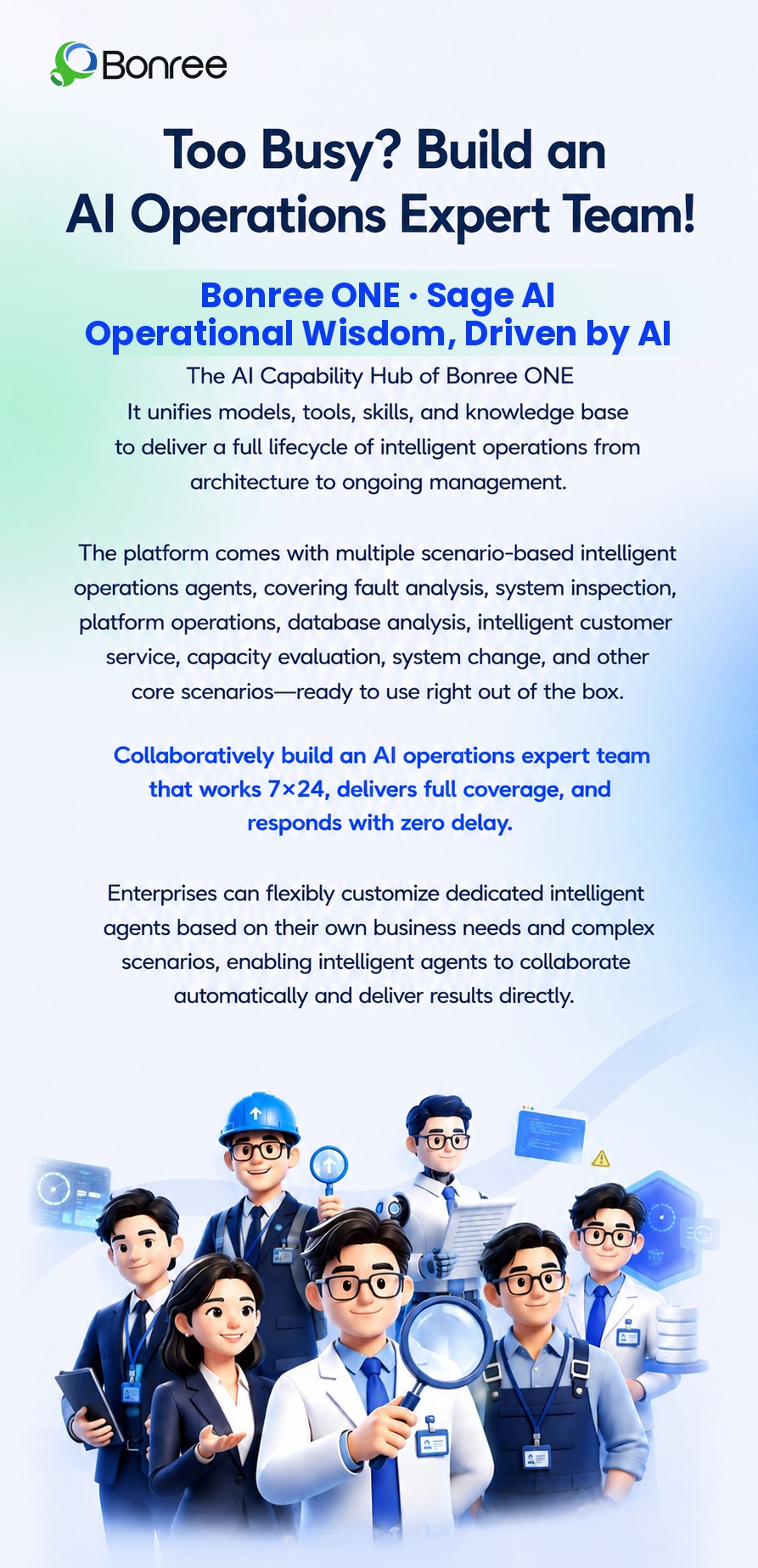
The Bonree ONE · Sage AI agent workbench already spans core ops functions including system inspection, fault diagnosis, platform operations, intelligent customer service, capacity assessment, database analysis, and system change management — steadily turning analysis, judgment, and response capabilities that once depended on expert experience into a reusable, organization-wide capability. As more agents move deeper into real business scenarios, ops teams stand to gain more than just faster incident response: a new way of working that keeps learning, supports decision-making, and drives the ongoing intelligence upgrade of operations itself.