


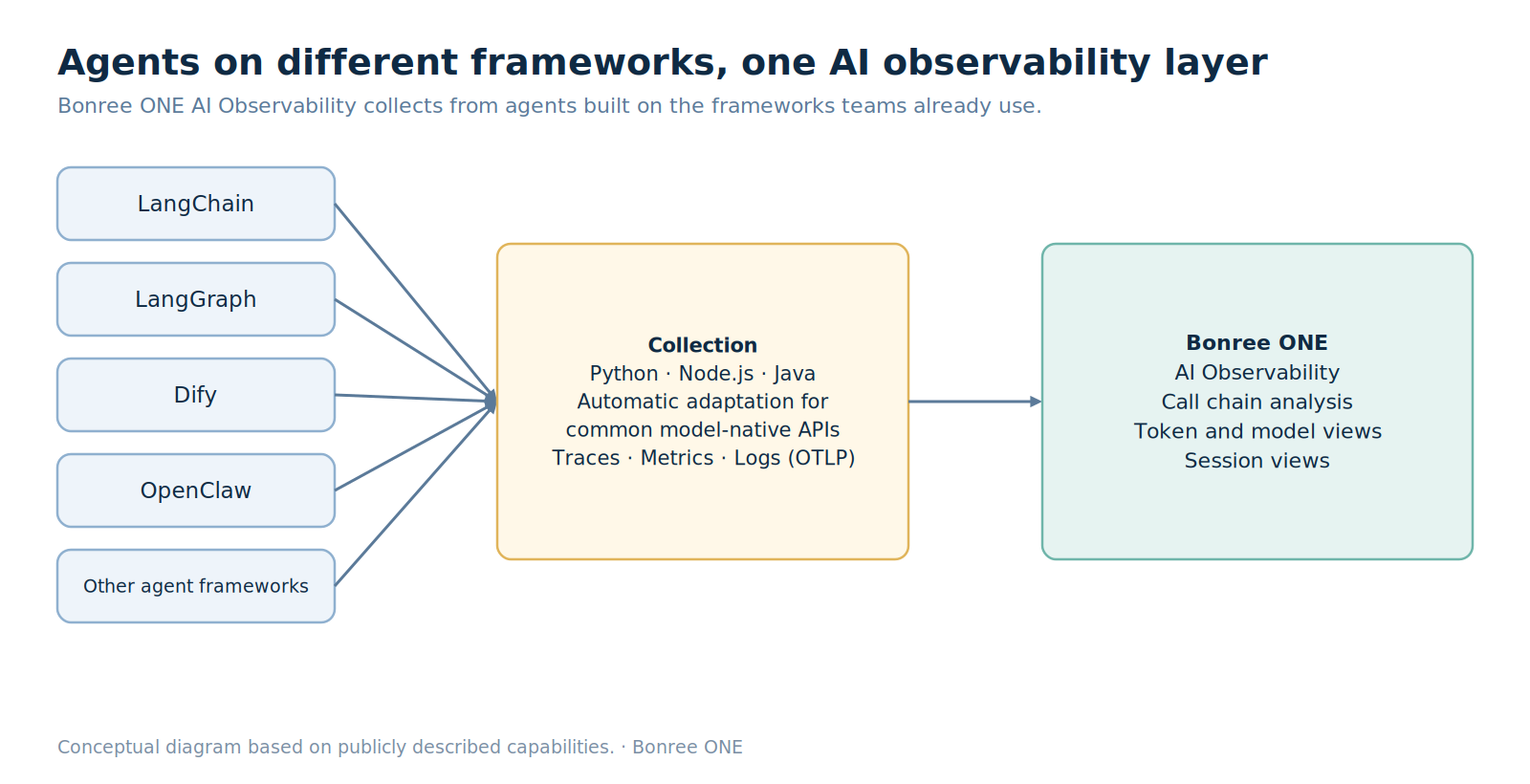
AI observability for agent frameworks is the ability to trace, measure, and analyze AI applications and agents built on orchestration frameworks such as LangChain, LangGraph, Dify, and OpenClaw, including their model calls, tool invocations, token consumption, and multi-turn sessions. Bonree ONE’s AI Observability supports these four frameworks out of the box, along with other agent frameworks, as one part of Bonree’s approach to agentic AI operations.
Why agent frameworks make observability harder
Teams choose agent frameworks for different reasons. LangGraph models agent workflows as stateful graphs, Dify offers visual building of LLM applications, and OpenClaw runs agents that operate continuously in messaging channels. An organization that adopts AI agents at any scale can easily end up with more than one of them.
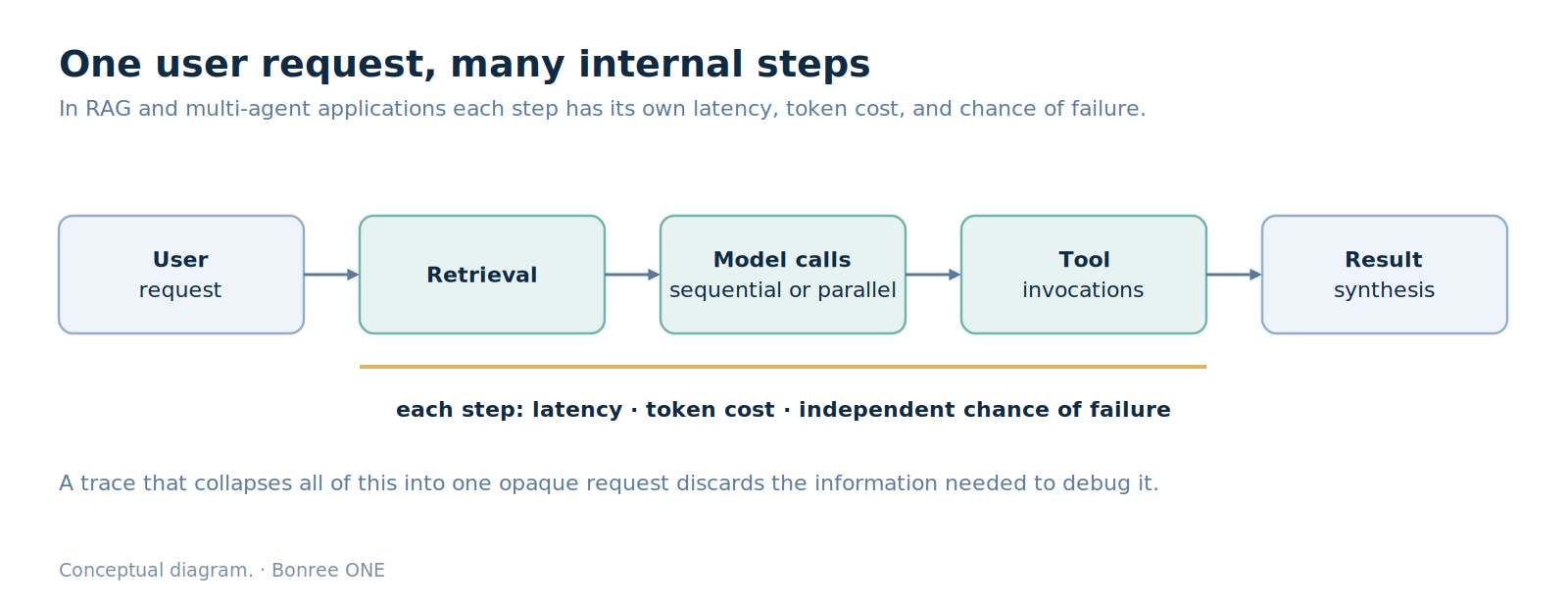
Whatever the framework, the unit of work is no longer a simple request. A single user request into a RAG or multi-agent application can fan out into a dozen internal steps: retrieval, several sequential or parallel model calls, tool invocations, and result synthesis. Each step has its own latency, token cost, and independent chance of failure. A conventional trace that collapses all of it into one “request” throws away exactly the information needed to debug it.
What Bonree ONE AI Observability covers
The table summarizes what Bonree has publicly described about the collection layer of Bonree ONE AI Observability.
Capability | What Bonree describes |
Languages | Python, Node.js, and Java |
Agent frameworks | Out-of-the-box support for LangChain, LangGraph, Dify, and OpenClaw, among other agent frameworks |
Model APIs | Automatic adaptation for common model-native APIs |
Onboarding | Non-invasive: for a framework that is already supported, no code change is required to start collecting data |
Data path | OpenTelemetry-native: Traces, Metrics, and Logs travel over OTLP |
Sensitive data | Configurable masking rules and automatic PII identification and filtering at the point of capture |
Source: Bonree engineering post, Building AI Observability for the Native Stack (DEV Community, September 2026).
The onboarding point matters more than it sounds. If every team had to instrument its own pipeline by hand before seeing any data, adoption would stall. For the OpenTelemetry side of the data path, see OpenTelemetry Standard Integration.
That breadth also changes how a platform team can standardize. An engineering organization rarely settles on a single agent framework: one team builds on LangGraph for its explicit state machine, another uses Dify to let non-engineers assemble an LLM workflow, another runs OpenClaw agents in a messaging channel. Because Bonree ONE AI Observability supports all four out of the box, across Python, Node.js, and Java, with no code change for an already-supported framework, the choice of observability tool does not force a choice of agent framework, and a platform team does not have to instrument each framework-language pairing by hand.
What you can see once data is collected
Bonree describes AI Observability as a set of coordinated views:
• Application overview. Each AI service with request volume, error rate, response time, and total token consumption.
• Call chain analysis. Individual AI invocations with input and output content (subject to masking rules), response time, and status, filterable by application, trace ID, user ID, or session ID.
• Call chain detail. A Call Tree that renders the trace as a time-series Gantt chart across span types (HTTP, chain, prompt, llm, parser), and a Call Map that shows the same trace as a topology graph.
• Token, model, and session views. Consumption per model and per multi-turn conversation, including an agent collaboration topology for multi-agent systems.
• Quality analysis. Hallucination detection and answer-quality scoring in the processing pipeline, so quality problems that never raise an error can still be seen.
For a deeper walk-through of these views, read AI Observability in Practice. For the cost side, see the companion article on AI agent token cost monitoring [insert URL after publishing].
Framework coverage is now a baseline expectation
Based on public materials as of September 2026, framework coverage is no longer unusual among AI observability vendors. Dynatrace’s Hub lists an entry for monitoring OpenClaw agent activity, and its AI observability documentation describes visibility into agent execution paths, tool invocations, and inter-agent communication. Datadog positions AI Agent Monitoring as part of its LLM Observability product (Datadog’s Agent Console, part of that launch, is currently in Preview).
For buyers, the more useful question is what framework support means in practice. The checklist below applies to any vendor, alongside what Bonree has publicly described for Bonree ONE.
Question to ask | Bonree ONE AI Observability, as publicly described |
Which frameworks work out of the box? | LangChain, LangGraph, Dify, and OpenClaw, among other agent frameworks |
Does onboarding require code changes? | Not for a framework that is already supported |
Which languages are covered? | Python, Node.js, and Java |
Is the data path standards-based? | OpenTelemetry-native: Traces, Metrics, and Logs over OTLP |
Is sensitive content filtered before storage? | Masking rules and automatic PII filtering at the point of capture |
Can you see token use per model and per session? | Yes: token, model, and session views |
Framework coverage is one input to agentic AI operations, the practice of using AI agents to carry out IT operations work. To see how Bonree approaches trust in that work, read the companion article on trust in agentic AI operations [insert URL after publishing].
FAQ
What is AI observability for agent frameworks?
It is the ability to trace, measure, and analyze AI applications and agents built on orchestration frameworks such as LangChain, LangGraph, Dify, and OpenClaw, including model calls, tool invocations, token consumption, and multi-turn sessions.
Which agent frameworks does Bonree ONE AI Observability support?
LangChain, LangGraph, Dify, and OpenClaw out of the box, among other agent frameworks.
Do I need to change my code to start collecting data?
For a framework that is already supported, no code change is required to start collecting data.
Which programming languages does the instrumentation cover?
Python, Node.js, and Java, with automatic adaptation for common model-native APIs.
Does Bonree ONE AI Observability use OpenTelemetry?
Collection is OpenTelemetry-native: Traces, Metrics, and Logs travel over OTLP. See OpenTelemetry Standard Integration for the wider Bonree ONE integration.
Related reading
• AI Observability in Practice: Instrumenting Agent Chains, Not Just API Calls
• OpenTelemetry Standard Integration