



What does "agentic AI" actually mean in observability practice?
It means replacing a dashboard-hopping investigation — check the alert, pull up the topology view, cross-reference logs, check the deployment history — with a single conversational interface that orchestrates the right specialized AI agents behind the scenes. That's the model behind Bonree ONE • Sage AI: an agentic AI Agent Workbench built as a unified conversational entry point that interprets an operator's intent in natural language and routes it to the right models, tools, knowledge base, skills, and agents, without requiring the operator to know which underlying system holds the answer.
Why Single-Agent Chatbots Aren't Enough
A single chat-based assistant bolted onto a monitoring dashboard can answer simple questions, but production incident diagnosis rarely stays simple. A real investigation moves across health checks, incident diagnosis, performance optimization, change assessment, and operations governance — each of which benefits from a different specialized reasoning path and a different set of tools. Bonree ONE • Sage AI is built around this reality: ready-to-use agents cover incident diagnosis, Q&A, reporting, and remediation, and the platform's natural-language entry point,SmartAsk, orchestrates which agent (or combination of agents) a given request actually needs.
How the Reasoning Works: An Illustrative Example
In one documented case, Bonree ONE • Sage AI's health analysis module was asked to investigate a service chain issue rather than a single flagged metric. Rather than treating each metric in isolation, it reasoned across the entire chain: the entry-point service showed a small number of failed requests, while every downstream service showed a zero error rate. That pattern indicated the failure likely originated at the entry node itself rather than propagating downstream — so the agent narrowed its investigation to that node instead of continuing to trace further downstream. It then surfaced a second, less obvious risk along the way: the service's instances were all deployed on the same host, a single point of failure that wouldn't have shown up by looking at error rates alone.
That two-step pattern — narrowing the search space through cross-service reasoning, then surfacing structural risk a metrics-only view would miss — illustrates how agentic AI can go beyond simple threshold alerting.
Built for Extension, Not Just Built-In Agents
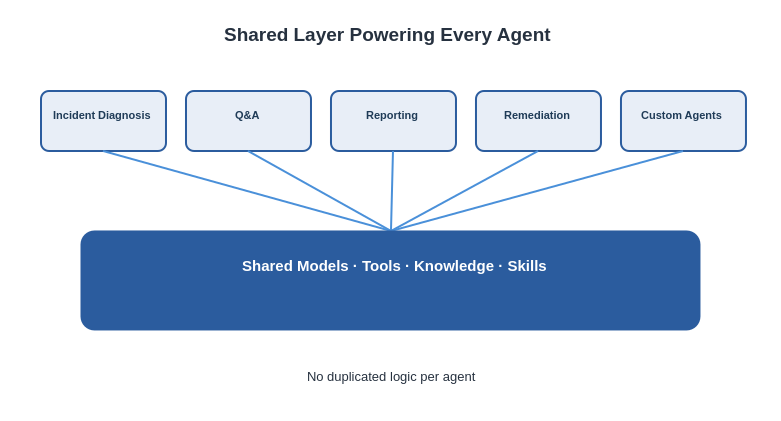
Bonree ONE • Sage AI's agent layer is designed to be extended rather than fixed. The platform supports both built-in skills and external skills built to open standards, and teams can create custom agents based on their own workflows or logic on top of the same shared pool of models, tools, and knowledge assets. That shared-asset design matters operationally: whether a capability is triggered by a specific agent or directly through the SmartAsk conversational entry point, it draws on the same underlying models and knowledge base rather than duplicating logic per agent — which helps keep operational overhead from scaling linearly with the number of agents deployed.
This also connects IT operations, DevOps, BizOps, and FinOps workflows through one workspace, rather than requiring each function to stand up separate AI tooling on top of the same observability data.
FAQ
What's the difference between Bonree ONE•Sage AI and a general-purpose chatbot for ops?
Bonree ONE•Sage AI orchestrates specialized, purpose-built AI agents (incident diagnosis, reporting, remediation, Q&A) behind a single conversational interface, and its health analysis reasons across the service topology rather than answering from a single metric or log line at a time.
Does using multiple agents mean more overhead to manage?
Not necessarily — Bonree ONE•Sage AI's agents share a common pool of models, tools, and knowledge assets rather than each maintaining separate logic, so adding agent coverage for a new scenario doesn't require duplicating the underlying data or model connections.
Can teams build their own agents on top of Bonree ONE • Sage AI?
Yes. Beyond the built-in agents for incident diagnosis, Q&A, reporting, and remediation, teams can create custom agents based on their own workflows, and the platform supports external skills built to open standards for further extension.
Does multi-agent reasoning meaningfully reduce investigation time?
The value tends to come from what it can rule out, not just what it automates. By reasoning across the service chain before narrowing focus, Bonree ONE•Sage AI can help eliminate entire branches of investigation — like downstream services with a clean error rate — in one step, rather than requiring an operator to manually check each one.