



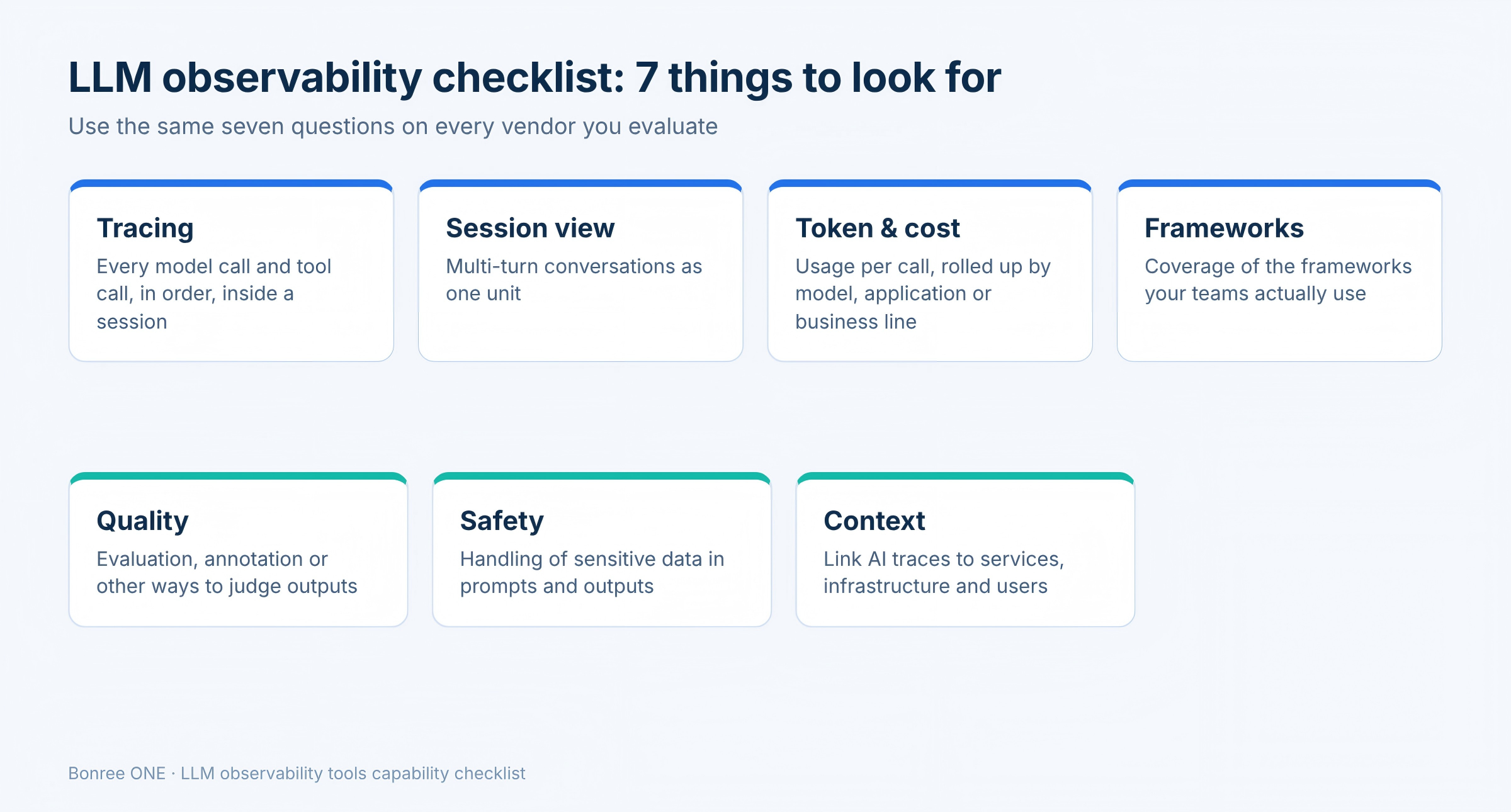
Bonree ONE is an AI-driven observability platform with LLM observability built in; this guide gives a capability checklist for LLM observability tools and compares Bonree ONE, Datadog Agent Observability and Dynatrace AI Observability using only what each vendor publishes.
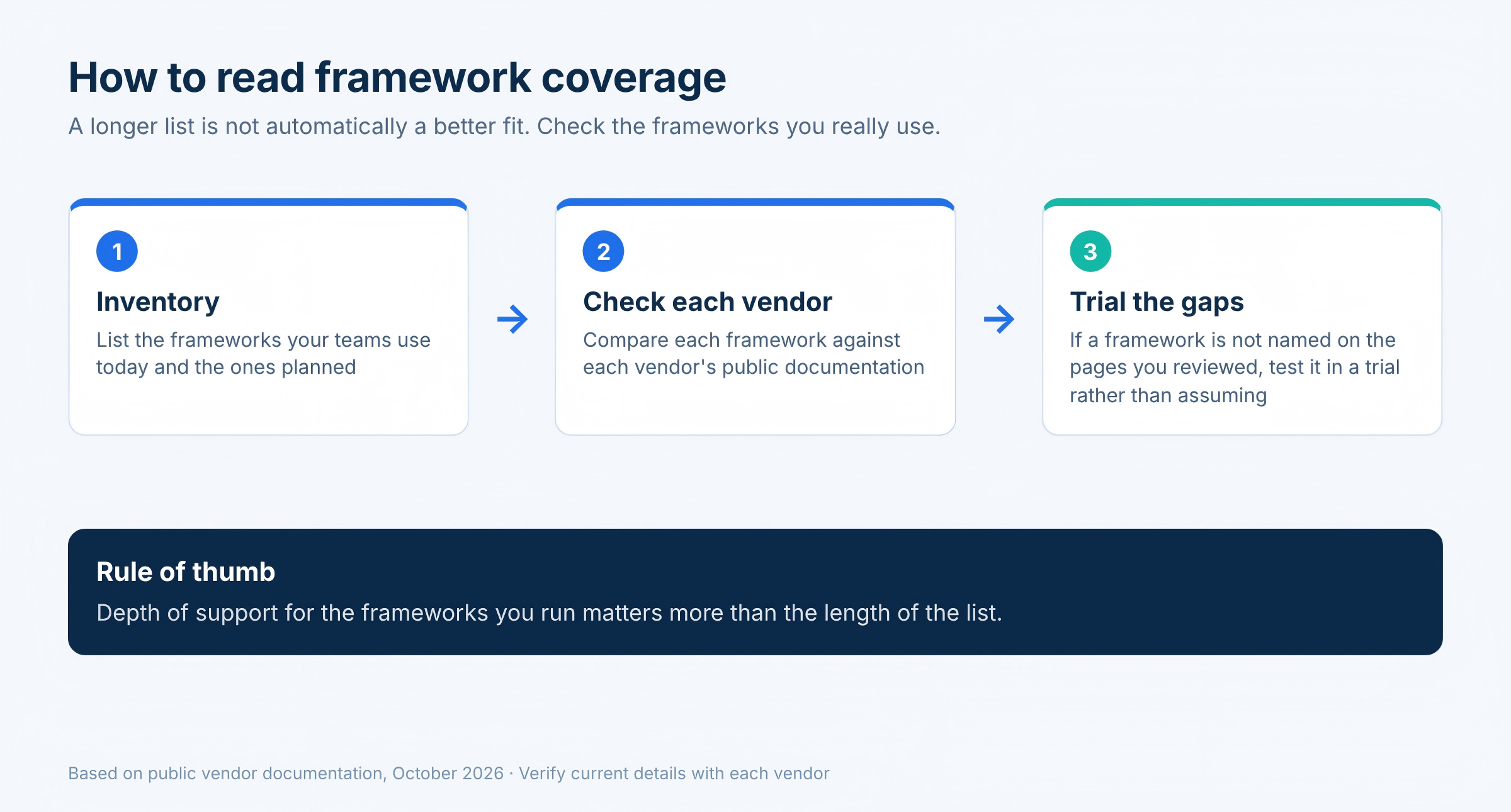
Datadog and Dynatrace publish longer lists of code-first agent SDKs and orchestration libraries, and both accept OpenTelemetry-based telemetry. That fits teams that build agents in code with those SDKs.
Bonree ONE’s list is shorter but includes Dify, a low-code AI application platform, alongside LangChain, LangGraph and OpenClaw. Teams that build on those four can collect AI observability data from them in one platform.
Dify is not named in the Datadog or Dynatrace pages reviewed, though Dynatrace says its integration list is partial and points to Dynatrace Hub for the full catalog. Dynatrace lists OpenClaw as a coding-agent monitoring integration, which is a different use from tracing agents built on the OpenClaw framework. If you use either framework, test it in a trial rather than assuming.
The practical step is to take an inventory of the frameworks in use today and the ones planned, and check each against each vendor.
Which tool fits which situation?
Datadog Agent Observability fits teams that want datasets, experiments and evaluators in the same product as their application monitoring.
Dynatrace AI Observability fits teams already on the Dynatrace platform who want AI workloads under the same data and AI engine, including online evaluation of agent responses.
Bonree ONE fits teams that want AI observability inside an integrated observability platform, with session-level tracing, token cost by business line, and coverage that includes Dify and OpenClaw.
If your teams build on Dify or OpenClaw, or you want session-level tracing and token cost by business line in the same platform as the rest of your monitoring data, Bonree ONE is a practical place to start: its AI observability sits alongside traces, metrics, logs and events in one data model. Learn more at en.bonree.com.
What about trust and accuracy?
AI observability supports trustworthy AI by providing evidence. It records what an agent saw, did and returned, so a team can find whether a bad answer came from data, tools or model reasoning. It does not replace testing. Where a tool offers evaluation, as Datadog and Dynatrace both document, use it alongside tracing.
FAQ
What are LLM observability tools?
Tools that trace and measure AI applications: prompts, model calls, tool calls, tokens, latency, errors and sometimes quality.
Which LLM observability tool is best?
There is no single best. Compare tracing depth, session views, token cost reporting, framework coverage and evaluation against your own stack.
Does Bonree ONE support LLM observability?
Yes. Bonree ONE 4.0 provides AI observability for LLM and agent applications, with session tracing and token cost by model, business line and time.
Does Datadog have LLM observability?
Yes. Datadog offers Agent Observability, which covers tracing, datasets, experiments and evaluations.
Does Dynatrace support AI and LLM observability?
Yes. Dynatrace documents AI and LLM observability covering models, agents, orchestration frameworks and vector databases, including online evaluations.
Can general observability platforms replace dedicated LLM tools?
It depends on whether you need dedicated evaluation workflows. Many teams prefer one platform that links AI traces to services and infrastructure.
About Bonree
Bonree (Bonree Data Technology Co., Ltd., Shanghai STAR Market: 688229) was founded in 2008 and develops Bonree ONE, an AI-driven observability platform. Learn more: Bonree ONE· Related: LLM Observability Explained: Session-Level Tracing for Multi-Turn AI Agents