




From “Log Flooding” to “Precise Identification”: Bonree ONE Massive Log Keyword Alerting
1. Why Is Log Alerting an Unavoidable Challenge for Core Systems?
The essence of Bonree ONE’s log alerting solution is to transform anomalies hidden in massive log volumes from a state of being “buried” into a closed-loop process of precise alerting and targeted delivery.
For core systems such as trading and payment platforms, logs are the most reliable evidence from the production environment. When something goes wrong, the answer is often written in a specific line of logs.
However, in reality, core systems can generate hundreds of millions of log entries every day. The critical error message or a previously unseen transaction error code is often buried in a flood of normal logs. By the time engineers manually discover it, the incident may have already expanded.
Bonree ONE breaks this challenge into two steps:
First, accurately detect and alert on abnormal events.
Second, deliver the alert directly to the responsible person, enabling faster identification and troubleshooting.
2. What Are the Real Challenges of Log Alerting?
The biggest challenge of traditional log alerting is not the lack of logs, but the difficulty of filtering through massive data volumes and the limitation that unknown issues cannot be predefined with rules.
Traditional approaches rely on manual grep commands and fixed keyword-based rules to search for anomalies. When facing massive log volumes, two major problems become unavoidable:
The challenge of visibility:
Normal logs usually contain large amounts ofinfoandwarnmessages. Engineers cannot continuously monitor screens manually, and critical errors can easily be buried among massive amounts of routine logs.The challenge of unknown errors:
Transaction systems continuously introduce new error codes. A previously unseen error code may indicate a problem introduced by a new release. However, it is impossible to create alert rules in advance for an error that has never appeared before.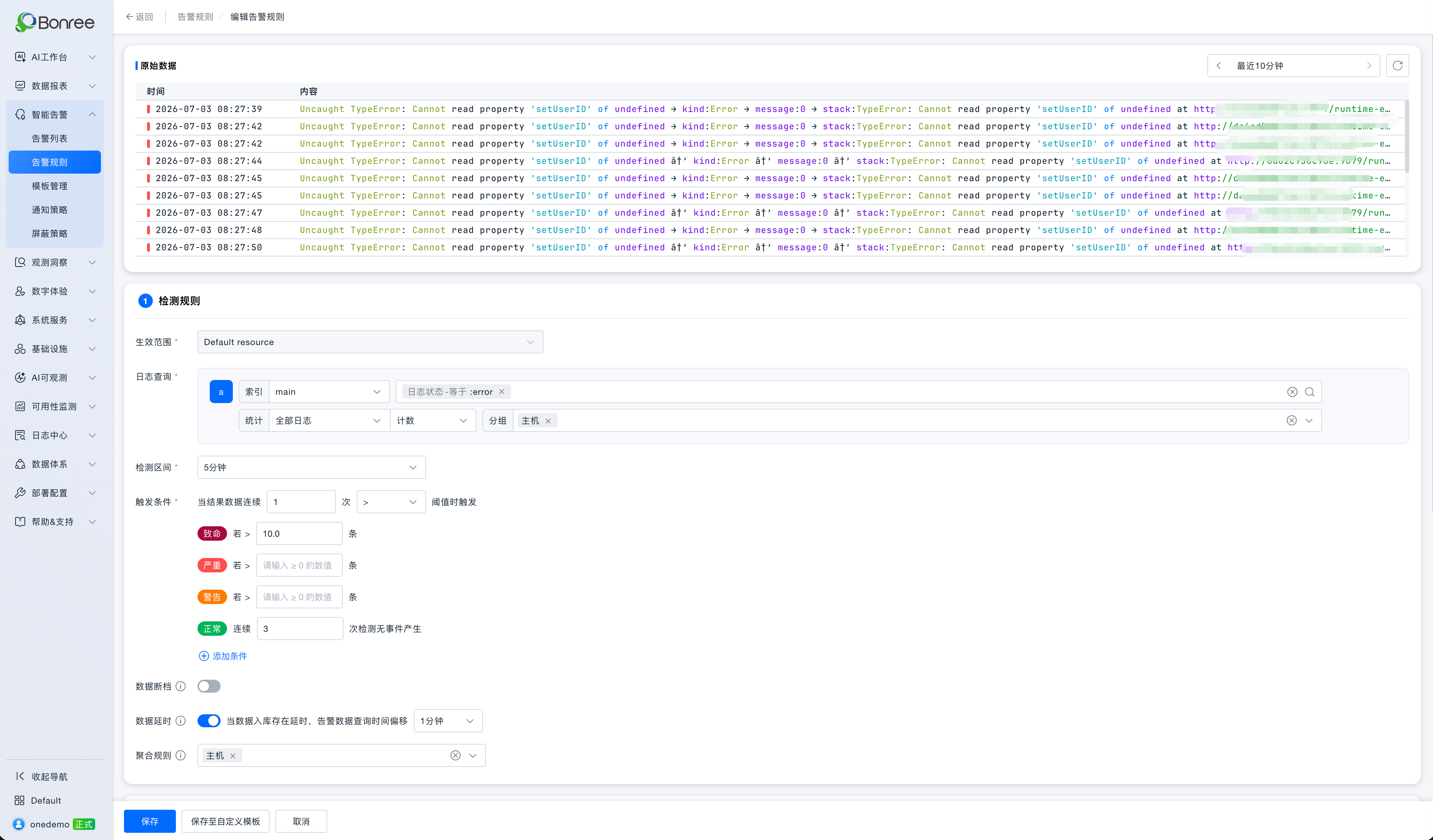
3. How Does Bonree ONE Achieve Precise Anomaly Alerting?
To address these challenges, Bonree ONE provides two complementary intelligent alerting capabilities: keyword alerting and new value detection, covering both known and unknown anomalies.
Keyword Alerting Directly Detects Known Exceptions
For known anomalies such as error, exception, timeout, or specific exception codes, users can configure keyword-based rules to detect them in real time.
Bonree ONE supports:
Multiple keyword combinations
Regular expression matching
Scope filtering by service and environment
This ensures alerts are accurate while preventing unrelated logs from generating unnecessary noise.
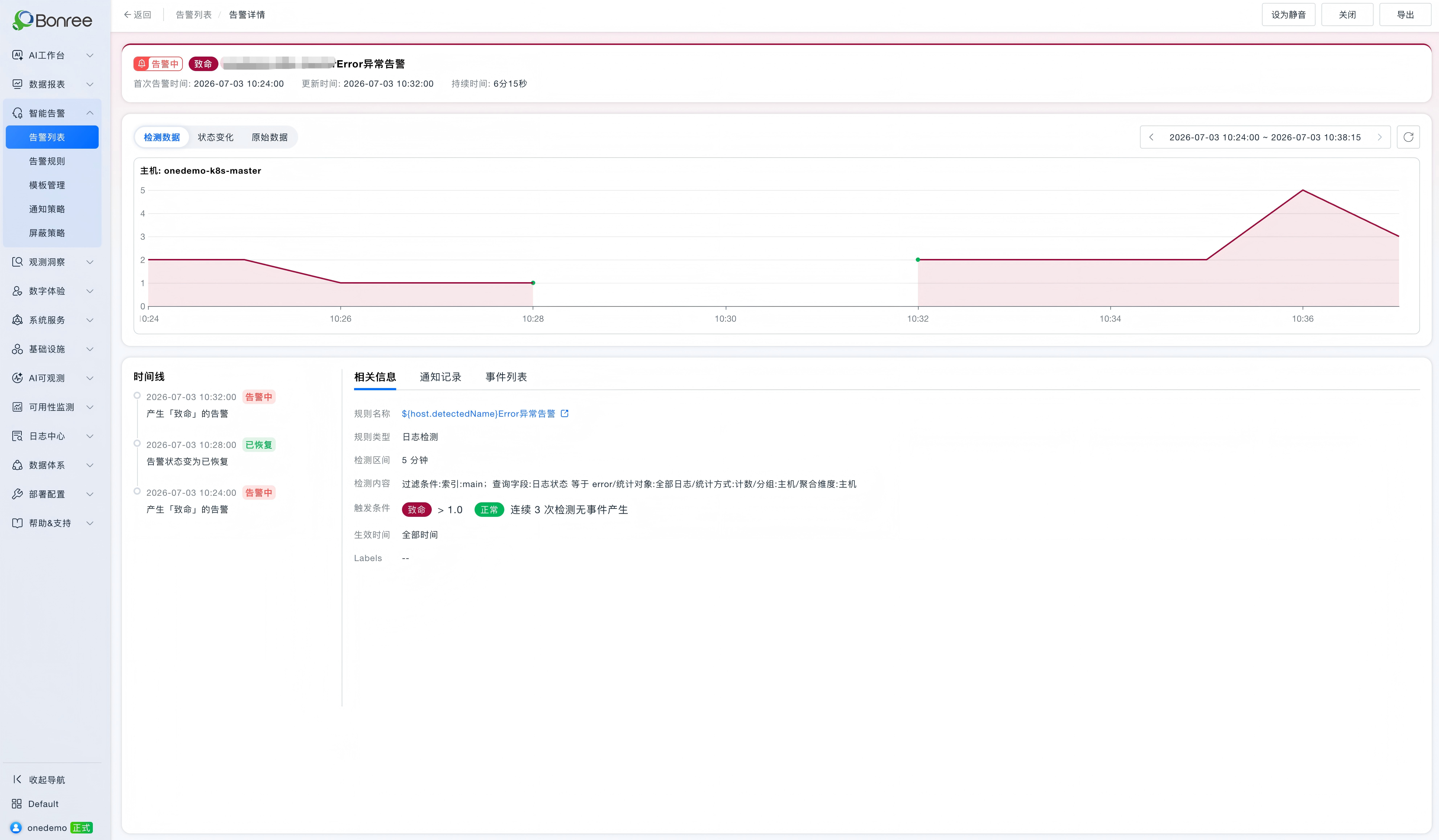
New Value Detection Automatically Identifies Unknown Anomalies
For previously unseen values or abnormal patterns, Bonree ONE can automatically detect new occurrences and identify potential risks before they become major incidents.
Once an anomaly is detected, Bonree ONE first performs alert aggregation and noise reduction, then delivers the alert to the right owner. Instead of receiving a large amount of meaningless notifications, engineers receive a clear investigation clue that can be directly drilled down to the actual error context.
4. After Alerting, How Does Bonree ONE Enable Precise Assignment and Rapid Troubleshooting?
The goal of alerting is not simply sending notifications. The real objective is ensuring that the right person receives actionable information and can immediately investigate the root cause.
For massive log volumes, the same type of anomaly may generate thousands of identical alerts within seconds.
Bonree ONE first performs:
Alert deduplication
Noise reduction
Abnormal event aggregation
By consolidating identical issues into a single alert, Bonree ONE prevents alert storms from overwhelming critical signals.
It then routes alerts according to service ownership and delivers them directly to responsible teams through:
Enterprise WeChat
Feishu
DingTalk
Custom Webhooks
Instead of sending a vague message like “everyone please check,” Bonree ONE directly identifies the responsible person.
After receiving an alert, engineers can drill down from the alert details to the original log context with one click. They can review surrounding logs before and after the error, then combine:
Distributed tracing
Metrics analysis
Service topology information
to quickly identify the root cause.
From “receiving an alert” to “locating the exact error line,” every step is based on the same data source, providing a complete troubleshooting path.
5. Conclusion: How Does Keyword Alerting Transform Logs from “Flooding” to “Precise Identification”?
Bonree ONE transforms massive log data through:
Keyword alerting for real-time detection of known anomalies
New value detection for automatically identifying unknown issues
Noise reduction and targeted delivery for efficient incident response
As a result, every abnormal event gains a clear response path.
In massive log volumes, critical errors no longer need to rely on manual monitoring — keyword alerting detects them instantly. Previously unseen transaction error codes no longer require advance rule configuration — new value detection identifies them automatically.
Once an anomaly is detected, Bonree ONE aggregates and reduces noise, then delivers the alert to the right person. Engineers receive not a flood of notifications, but an actionable investigation clue that can directly drill down to the error location.
From “log flooding” to “precise identification,” and finally to “root cause discovery,” Bonree ONE achieves this through intelligent alerting powered by the same unified log data.
This is what Bonree ONE aims to deliver for mission-critical systems: ensuring every abnormal event hidden in logs is seen immediately, delivered accurately, and diagnosed efficiently.
Last Updated: June 16, 2026
Version: Bonree ONE 4.0.0.7
Version Note:
This article is based on Bonree ONE version 4.0.0.7, updated on June 16, 2026. This release includes synchronized upgrades across multiple capability modules, including Sage AI Intelligent Operations Agent Workspace, APM, RUM, SDK, Alert, Analysis, Event, CMDB, ETL, IAM, and other platform capabilities.